


How to integrate Missive MCP with Hermes

Hermes is a 24/7 autonomous agent that lives on your computer or server — it remembers what it learns and evolves as your usage grows. This guide explains the easiest and most robust way to connect your Missive account to Hermes. You can do this through either Composio Connect CLI or Composio Connect MCP. For personal use we recommend the CLI, but you won't go wrong with MCP either.
Missive logoMissive
Api Key

Missive is a collaborative email and chat app for teams to manage conversations and tasks together. It helps streamline team inboxes, shared labels, and internal discussion in one place.

40 Tools

Introduction

Hermes is a 24/7 autonomous agent that lives on your computer or server — it remembers what it learns and evolves as your usage grows.

This guide explains the easiest and most robust way to connect your Missive account to Hermes. You can do this through either Composio Connect CLI or Composio Connect MCP. For personal use we recommend the CLI, but you won't go wrong with MCP either.

Also integrate Missive with

What is Composio Connect?

Composio Connect is a consumer offering that lets anyone plug 1,000+ applications directly into their agent harness — including Hermes. It can:

  • Search and load tools from relevant toolkits on-demand, reducing context usage.
  • Chain multiple tools to accomplish complex workflows via a remote workbench, without excessive back-and-forth with the LLM.
  • Manage app authentication end-to-end with zero manual overhead.

Integrating Missive with Hermes

Using Composio Connect CLI

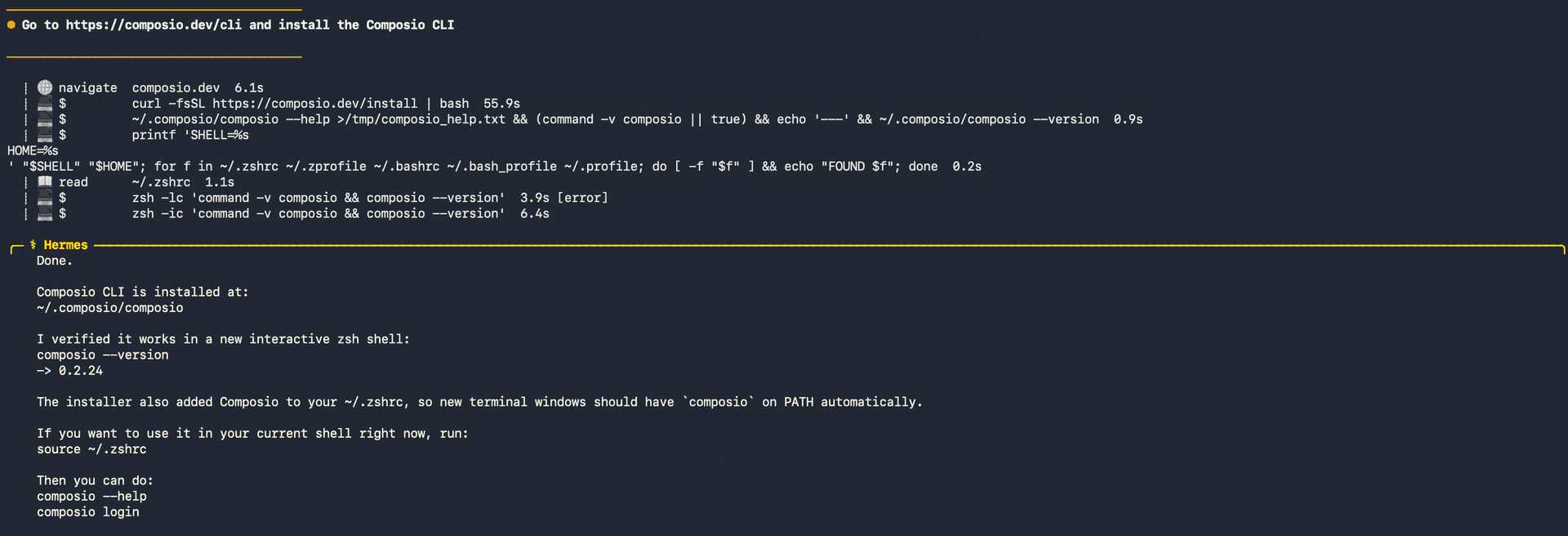
1. Install the Composio CLI

Run the install script directly, or paste https://composio.dev/hermes into your Hermes chat box to have it installed for you.

bash
curl -fsSL https://composio.dev/install | bash
Hermes authenticating with Composio

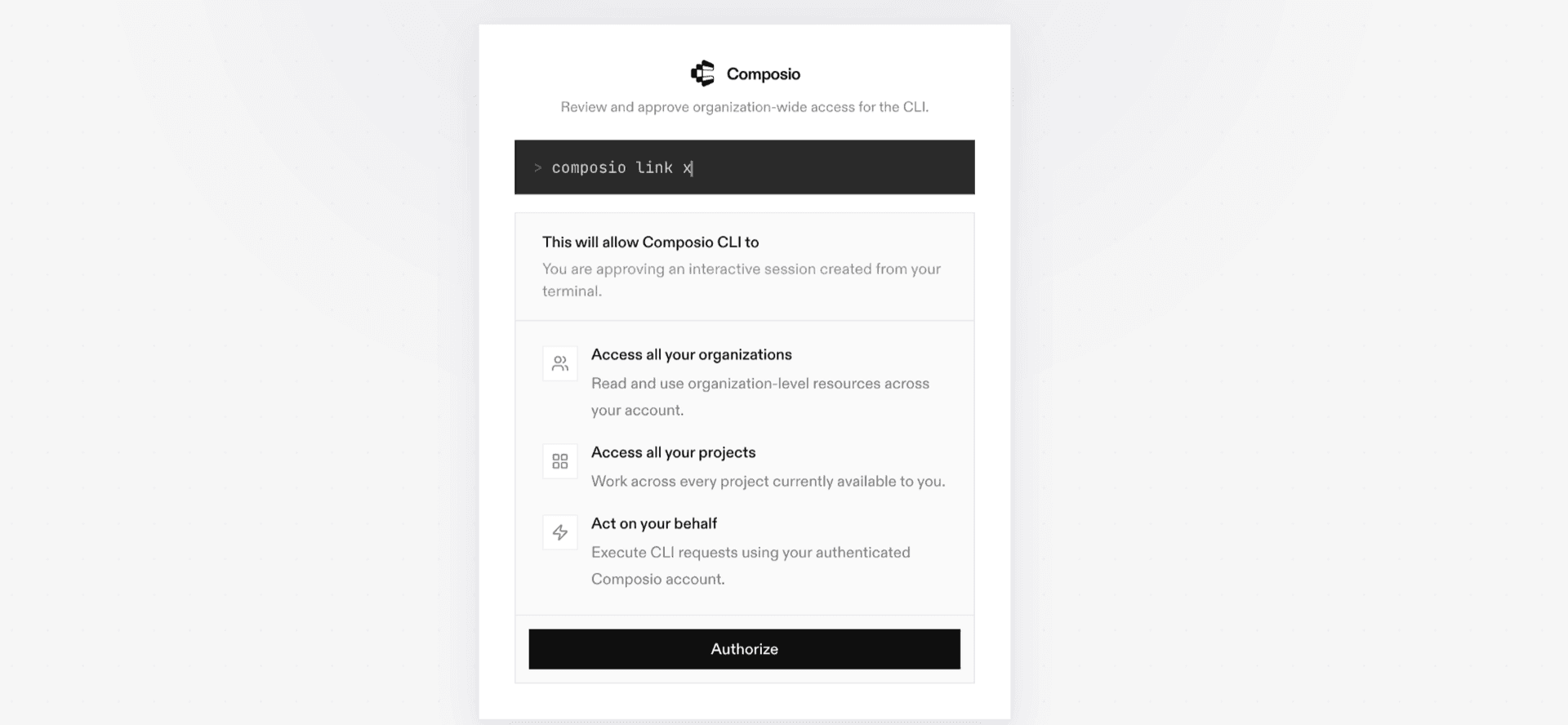
2. Authenticate

Once the CLI is installed, ask Hermes to authenticate with Composio.

3. Connect to Missive

Ask your agent to connect to Missive, or simply request any Missive-related task. Hermes will prompt you to authenticate and authorize access.

4. Done. You're all set with a new Missive connection.


Using Composio Connect MCP

1. Get your MCP URL and API Key

Go to dashboard.composio.dev and copy your Connect MCP URL and API key.

Copy MCP URL and API key from Composio dashboard

2. Open the Hermes config file

bash
nano ~/.hermes/config.yaml

3. Add the Composio Connect MCP server

bash
mcp_servers:
  composio:
    url: "https://connect.composio.dev/mcp"
    headers:
      x-consumer-api-key: "YOUR_COMPOSIO_API_KEY"
    connect_timeout: 60
    timeout: 180

Save with Ctrl + O, Enter, then exit with Ctrl + X.

4. Restart your Hermes agent

Once restarted, ask your agent to connect to Missive or request any Missive-related task. It will prompt you to authenticate and authorize access.

5. Done!

What is the Missive MCP server, and what's possible with it?

The Missive MCP server is an implementation of the Model Context Protocol that connects your AI agent and assistants like Claude, Cursor, etc directly to your Missive account. It provides structured and secure access to your team's shared inboxes and chat threads, so your agent can perform actions like drafting emails, sending messages, generating reports, and managing team communication on your behalf.

  • Automated message drafting and scheduling: Let your agent create and save email, SMS, WhatsApp, or live chat drafts for later editing or scheduled sending.
  • Instant message sending in conversations: Have your agent send new messages directly to any Missive conversation, keeping your team in the loop in real time.
  • Team and user management: Effortlessly list all teams and their members, or pull a full directory of users in your Missive organization for easy coordination and task assignment.
  • Analytics report generation: Direct your agent to create detailed analytics reports across time ranges and filters, helping your team track productivity and engagement.
  • Webhook automation setup: Enable your agent to create or delete webhook subscriptions, so you can automate notifications and integrations with other tools as needed.

Way Forward

With Missive connected, Hermes can now act on your behalf whenever it detects a relevant task or you ask it to.

From here, you can extend Hermes further:

  • Connect more apps: Calendar, Slack, Notion, Linear, and hundreds of others are available through the same Composio Connect setup. Each new integration compounds what Hermes can do for you.
  • Build workflows across tools: Once multiple apps are connected, Hermes can chain actions together — turn an email into a calendar invite, a Slack message into a Linear ticket, or a meeting note into a follow-up draft.
  • Let it learn your patterns: The more you use Hermes, the better it gets at anticipating how you'd handle recurring tasks. Give it feedback on drafts and decisions, and it will adapt.

If you run into trouble or want to share what you've built, join the community or check out the Docs for deeper configuration options.

TOOLS

Supported Tools

Every Missive action and event your agent gets out of the box.

Create Analytics Report

Tool to create an analytics report.

Create Missive Contacts

Tool to create one or more contacts in a Missive contact book.

Create Draft

Tool to create a new draft in Missive.

Create Missive Post

Tool to create a post in a Missive conversation.

Create Canned Response

Tool to create one or more canned responses (templates) in Missive.

Create Shared Label

Tool to create one or more shared labels at the organization level.

Create Missive Task

Tool to create a task in Missive.

Create Team

Tool to create a new team in an organization.

Create Webhook

Tool to create a webhook subscription.

Delete Draft

Tool to delete a draft from a conversation by draft ID.

Delete Post

Tool to delete a post from a conversation by post ID.

Delete Saved Responses

Tool to delete one or more saved responses by ID.

Delete Webhook

Tool to delete a webhook subscription by webhook ID.

Get Analytics Report

Tool to fetch a completed analytics report using its ID.

Get Missive Contact

Tool to fetch a specific contact using the contact ID.

Get Missive Conversation

Tool to fetch full conversation metadata (assignees/users/labels/team/org) for a specific conversation ID.

List Conversation Messages

Tool to list messages belonging to a Missive conversation (newest first).

Get Missive Message

Tool to fetch full message details including headers, HTML body, and attachments.

Get Missive Response

Tool to fetch a specific saved response using the response ID.

Get Missive Task

Tool to get a single task by ID with full details including assignees, team, and conversation info.

List Missive Contact Books

Tool to list contact books the authenticated user has access to.

List Missive Contact Groups

Tool to list contact groups or organizations linked to a contact book.

List Missive Contacts

Tool to list contacts from a contact book.

List Conversation Comments

Tool to list comments in a Missive conversation ordered from newest to oldest.

List Conversation Drafts

Tool to list draft messages in a Missive conversation (newest first).

List Conversation Posts

Tool to list posts in a Missive conversation ordered by newest first.

List Missive Conversations

Tool to list conversations visible to the authenticated user ordered by newest activity first.

List Messages by Message-ID

Tool to fetch messages matching an email Message-ID header.

List Missive Organizations

Tool to list organizations the authenticated user is part of.

List Missive Saved Responses

Tool to list saved responses (canned responses/templates) for the authenticated user.

List Missive Shared Labels

Tool to list shared labels (organization-level labels) available to the authenticated user.

List Missive Tasks

Tool to list tasks accessible to the authenticated user.

List Missive Teams

Tool to list all teams.

List Missive Users

Tool to list all users.

Merge Missive Conversations

Tool to merge multiple conversations into one.

Update Missive Contact

Tool to update one or more contacts in Missive.

Update Saved Response

Tool to update one or more saved responses in Missive.

Update Shared Labels

Tool to update one or more shared labels in Missive.

Update Missive Task

Tool to update an existing task's attributes in Missive.

Update Missive Team

Tool to update one or more teams in Missive.

FAQ

Frequently asked questions

With a standalone Missive MCP server, the agents and LLMs can only access a fixed set of Missive tools tied to that server. However, with the Composio Tool Router, agents can dynamically load tools from Missive and many other apps based on the task at hand, all through a single MCP endpoint.

Yes, you can. Hermes fully supports MCP integration. You get structured tool calling, message history handling, and model orchestration while Tool Router takes care of discovering and serving the right Missive tools.

Yes, absolutely. You can configure which Missive scopes and actions are allowed when connecting your account to Composio. You can also bring your own OAuth credentials or API configuration so you keep full control over what the agent can do.

All sensitive data such as tokens, keys, and configuration is fully encrypted at rest and in transit. Composio is SOC 2 Type 2 compliant and follows strict security practices so your Missive data and credentials are handled as safely as possible.

Start with Missive.It takes 30 seconds.

Managed auth, hosted MCP servers, and every Missive tool your agent needs.Free to start.

Start building